By William K. Black
(Cross-posted from Benzinga.com)
We continue to witness remarkable developments inthe intersection of the related fields of economics, finance, ethics, law, andregulation. Each of these five fieldsignores a sixth related field – white-collar criminology. The six fields share a renewed interest intrust. The key questions are why wetrust (some) others, when that trust is well-placed, and when that trust isharmful. Only white-collarcriminologists study and write extensively about the last question. The primary answer that the five fields giveto the first question is reputation. Thefive fields almost invariably see reputation as positive and singular. This is dangerously naïve. Criminals often find it desirable to developmultiple, complex reputations and the best way for many CEOs to develop asterling reputation is to lead a control fraud. Those are subjects for futurecolumns.
This column focuses on theoclassical economics’ useof reputation as “trump” to overcome what would otherwise be fatal flaws intheir theories and policies. FrankEasterbrook and Daniel Fischel, the leading theoclassical “law and economics”theorists in corporate law, use reputation in this manner to explain why seniorcorporate officers’ conflicts of interest pose no material problem. The most dangerous believer in the trump,however, was Alan Greenspan. Hisstandard commencement speech while Fed Chairman was an ode to reputation as thecharacteristic that made possible trust and free markets. I’ve drawn on excerpts from one example, his May15, 2005 talk at Wharton.
I find Greenspan’s odes to reputation as theantidote to fraud to be historically inaccurate and internally inconsistent intheir logic. Here, I ignore his factualerrors and focus on his logical consistency.
|
“The principles governing business behavior are an essential support to voluntary exchange, the defining characteristic of free markets. Voluntary exchange, in turn, implies trust in the word of those with whom we do business.
Trust as the necessary condition for commerce was particularly evident in freewheeling nineteenth-century America, where reputation became a valued asset. Throughout much of that century, laissez-faire reigned in the United States as elsewhere, and caveat emptor was the prevailing prescription for guarding against wide-open trading practices. In such an environment, a reputation for honest dealing, which many feared was in short supply, was particularly valued. Even those inclined to be less than scrupulous in their personal dealings had to adhere to a more ethical standard in their market transactions, or they risked being driven out of business.
To be sure, the history of world business, then and now, is strewn with Fisks, Goulds, Ponzis and numerous others treading on, or over, the edge of legality. But, despite their prominence, they were a distinct minority. If the situation had been otherwise, late nineteenth- and early twentieth-century America would never have realized so high a standard of living.
* * *
Over the past half-century, societies have chosen to embrace the protections of myriad government financial regulations and implied certifications of integrity as a supplement to, if not a substitute for, business reputation. Most observers believe that the world is better off as a consequence of these governmental protections. Accordingly, the market value of trust, so prominent in the 1800s, seemed by the 1990s to have become less necessary. But recent corporate scandals in the United States and elsewhere have clearly shown that the plethora of laws and regulations of the past century have not eliminated the less-savory side of human behavior. We should not be surprised then to see a re-emergence of the value placed by markets on trust and personal reputation in business practice. After the revelations of recent corporate malfeasance, the market punished the stock and bond prices of those corporations whose behaviors had cast doubt on the reliability of their reputations. There may be no better antidote for business and financial transgression. But in the wake of the scandals, the Congress clearly signaled that more was needed.
The Sarbanes-Oxley Act of 2002 appropriately places the explicit responsibility for certification of the soundness of accounting and disclosure procedures on the chief executive officer, who holds most of the decisionmaking power in the modern corporation. Merely certifying that generally accepted accounting principles were being followed is no longer enough. Even full adherence to those principles, given some of the imaginative accounting of recent years, has proved inadequate. I am surprised that the Sarbanes-Oxley Act, so rapidly developed and enacted, has functioned as well as it has. It will doubtless be fine-tuned as experience with the act’s details points the way.
It seems clear that, if the CEO chooses, he or she can, by example and through oversight, induce corporate colleagues and outside auditors to behave ethically. Companies run by people with high ethical standards arguably do not need detailed rules on how to act in the long-run interest of shareholders and, presumably, themselves. But, regrettably, human beings come as we are–some with enviable standards, and others who continually seek to cut corners.
I do not deny that many appear to have succeeded in a material way by cutting corners and manipulating associates, both in their professional and in their personal lives. But material success is possible in this world, and far more satisfying, when it comes without exploiting others. The true measure of a career is to be able to be content, even proud, that you succeeded through your own endeavors without leaving a trail of casualties in your wake.
* * *
Our system works fundamentally on trust and individual fair dealing. We need only look around today’s world to realize how valuable these traits are and the consequences of their absence. While we have achieved much as a nation in this regard, more remains to be done.”
|
Greenspan appears to have relied on the trump ofreputation as the basis for causing the Fed to oppose financial regulationgenerally and at least five specific examples of proposed or existingregulation designed to deal with conflicts of interest. He supported the repeal of the Glass-SteagallAct despite the conflict of interest inherent in combining commercial andinvestment banking. He supported thepassage of the Commodities Futures Modernization Act of 2000 despite agencyconflicts between managers and owners of firms purchasing and selling creditdefault swaps (CDS). He opposed usingthe Fed’s unique statutory authority under HOEPA (1994) to regulate banfraudulent liar’s loans by entities not regulated by the Federalgovernment. He opposed efforts to cleanup outside auditors’ conflict of interest in serving as auditor and consultantto clients. He opposed efforts to cleanup the acute agency conflicts of interest caused by modern executivecompensation. He opposed taking aneffective response to the large banks acting on their perverse conflicts ofinterest to aid and abet Enron’s SPV frauds.
Greenspan’shypothesis: reputation trumps perverse incentives
Greenspan’s overall anti-regulatory hypothesis seemsto be that laissez faire led tosubstantial control fraud, which gave business actors a strong incentive toavoid being defrauded. This caused themto care a great deal about reputation, which successfully prevented fraud. Indeed, the frauds “had to adhere to a more ethicalstandard in their market transactions, or they risked being driven out ofbusiness.”
The mostobvious logic problem with this hypothesis is why laissez faire led to substantial control fraud. Here is his key sentence, discussing businesslife under laissez faire: “In such an environment, a reputation forhonest dealing, which many feared was in short supply, was particularly valued.” How could “many” American business peopleoperating under laissez faire fearthat reputations for honest dealing were “in short supply” among theircounterparts? Under Greenspan’s logicreputations for honest dealing should have been omnipresent among Americanbusiness people during laissez faire. Greenspan assures us that under laissez faire even frauds “had to adhereto a more ethical standard in their market transactions, or they risked beingdriven out of business.” If this istrue, then the “many” who “fear[ed]” that “a reputation for honest dealing “wasin short supply” must have been irrational. Reputations for honest dealing should have been virtually universalunder Greenspan’s logic.
Markets make the Mensch
Greenspanasserted that unethical CEOs who act like scum in their personal lives engagedin a daily “Road to Damascus” conversion whenever they worked. Greenspan concedes that CEOs dominatecorporations and that a honest CEO will prevent any material corporate fraud (“ifthe CEO chooses, he or she can, by example and through oversight, inducecorporate colleagues and outside auditors to behave ethically”). In short, Greenspan asserts (contrary to AdamSmith’s warnings) that there is no serious “agency” problem caused by theseparation of ownership and control in corporations. Markets force CEOs to act as if they werehonest because a good reputation is essential to the CEO. The CEO, in turn, is able to ensure thatsubordinates act ethically. ButGreenspan then contradicts his logic again, despairing that: “regrettably, human beings come as weare–some with enviable standards, and others who continually seek to cutcorners.” Greenspan has just assertedthat humans do not “come as we are”to business. Markets force us to behaveas if we are moral regardless of our actual morality. When we are in our business mode we are atour patriarchal Grandfather’s house on our best behavior in constant fear ofarousing his ire.
Greenspan claimed that we were inthe midst of a renewal of CEO honesty – in 2005
InSeptember 2004, the FBI warned that there was an “epidemic” of mortgage fraudand predicted that it would cause a financial “crisis” if it were notcontained. The fraud epidemic grewmassively, and I have shown why we know that it was overwhelmingly lenders whoput the lies in liar’s loans – at a rate of roughly a million fraudulentmortgages annually at the time that Greenspan gave his talk at Wharton inmid-2005.
“We should not be surprised then to see a re-emergence ofthe value placed by markets on trust and personal reputation in businesspractice. After the revelations of recent corporate malfeasance, the marketpunished the stock and bond prices of those corporations whose behaviors hadcast doubt on the reliability of their reputations. There may be no betterantidote for business and financial transgression.”
Again, myemphasis here is on Greenspan’s logic. It does not follow that because “the market punished the stock and bondprices of those corporations” that collapsed because they were looted by theirCEOs this served as the best “antidote” to prevent future accounting controlfrauds. George Akerlof and Paul Romerpublished their famous article in 1993 (“Looting: the Economic Underworld ofBankruptcy for Profit”). Indeed, GeorgeAkerlof received the Nobel Prize in economics in 2001. Greenspan was Charles Keating’s principaleconomic expert and had seen him loot Lincoln Savings in the late 1980s. Accounting control frauds are funded by stockand bond sales. The markets fundaccounting control frauds, and they do so massively even when the CEO islooting the firm and causing losses principally to the shareholders andcreditors. The CEO walks away wealthyfrom the husk of the failed corporation. Almost everyone agrees that leverage is one of the great causes oflosses in our recurrent, intensifying financial crises here and abroad. Debt drives leverage. Debt is supposed to provide the “privatemarket discipline” that prevents accounting control fraud, and reputation issupposed to be the piston that adds immense power to this great brake. But accounting control fraud, as Akerlof& Romer (and we criminologists) emphasize is a “sure thing” – it producesrecord (albeit fictional) profits in the near-term. When there are epidemics of accountingcontrol fraud, bubbles hyper-inflate. The combined result is that loss recognition is hidden byrefinancing. Reporting record profitsand minor losses via accounting control fraud is the surest means for a CEO togrow wealthy and develop a strong reputation. Creditors rush to lend to corporations reporting stellar results, whichis what produces the extraordinary leverage. Far from acting as an “antidote” to accounting control fraud, reputationhelps explain why private market discipline becomes an oxymoron. Reputation is the great booster shot aidingand encouraging accounting control fraud.
In anyanalogous context we would consider Greenspan’s “antidote” claim to be faciallyinsane. If the head of the public healthservice announced proudly that the service had triumphed because, while onemillion Americans had died of an epidemic of cholera, the death rate had beenso severe and rapid that the epidemic had burned out, we would consider him tobe delusional and heartless. The deathof the pathogen’s host (us) does not constitute a triumph over cholera. It also does not leave the survivors who werenot exposed to the pathogen with additional antibodies that will prevent futureepidemics.
“Texas Triumphs”
In an article I wrote in 2003 during the unfolding Enron-era frauds I calledsimilar claims by prominent Texas politicians that Enron’s failure representeda triumph of capitalism “Texas triumphs.”
I distinguished Texas triumphs from Pyrrhic victories. The origin of that phrase comes from King Pyrrhus’ (of Epirus in Greece) victory over theRomans in 279 BC at the battle of Asculum in Apulia (on the Eastern side of theItalian peninsula). The Roman legionswere elite and outnumbered Pyrrhus’ forces (which had many mercenaries). Nevertheless, he twice defeated the Romanforces, inflicting significantly greater casualties on their forces. After the battle of Asculum he responded tocongratulations by remarking that one more such victory would undo him. He was a great commander who defeated highlycompetent opponents defending their own lands.
Only theoclassical economists could call thefailure of our most elite firms that were looted by their CEOs a triumph ofcapitalism. I wrote:
“MartinWolf repeated the well-worn claim that Enron’s failure demonstratescapitalism’s virtues in 2003. It is aview most famously stated by Larry Lindsey, a member of George W. Bush’s first(failed) economic team, when he saidin January 2002 that Enron’s failure was “a tribute to American capitalism.” Thethen treasury secretary, Paul O’Neill, wasn’t to be outdone. He insistedEnron’s failure proved “the genius of capitalism.””
Our family’s rule that it isimpossible to compete with unintentional self-parody remains intact. Adiscipline (economics) that counts massive looting by the CEOs of elite controlfrauds as its greatest triumphs desperately needs an intervention. None of these control fraud failures (andthat includes Fannie and Freddie) involves valiant efforts by economists toprevent the looting. The theoclassicalfailures to prevent control fraud did not occur because the economists stroveto prevent the looting but were defeated by impossible odds. Theoclassical economists were theanti-regulatory architects of the criminogenic environments that produce ourepidemics of control fraud. They are theelite frauds’ most valuable allies.
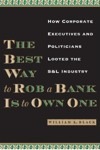
Bill Black is the author of The Best Way to Rob a Bank is to Own One and an associate professor of economics and law at the University of Missouri-Kansas City. He spent years working on regulatory policy and fraud prevention as Executive Director of the Institute for Fraud Prevention, Litigation Director of the Federal Home Loan Bank Board and Deputy Director of the National Commission on Financial Institution Reform, Recovery and Enforcement, among other positions.
Bill writes a column for Benzinga every Monday. His other academic articles, congressional testimony, and musings about the financial crisis can be found at his Social Science Research Network author page and at the blog New Economic Perspectives.




2 responses to “Greenspan’s Laissez Fairy Tale”