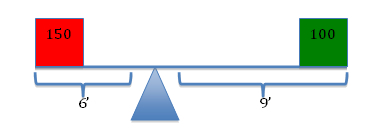
Imagine two people sitting on opposite ends of a 15-foot teeter-totter. The laws of physics dictate that the seesaw will balance if the product of the first mass (w1) and its distance (d1) from the fulcrum (i.e. the balancing point) is equal to the product of the other mass (w2) and its distance (d2) from the fulcrum. Thus, the physicist can show that the teeter-totter will be in balance when the fulcrum is placed 6 feet from the end holding a 150lb person and 9 feet from the end holding a 100lb person. Moreover, the laws of physics ensure that an imbalance will arise if the mass or the relative position of one of the people is changed.
The laws of accounting allow us to demonstrate that similarly powerful concepts apply to the science of economics. Beginning with the simple identity for GDP in a closed economy, we have:
[1] Y = C + I + G, where:
Y = GDP = National Income
C = Aggregate Consumption Expenditure
I = Aggregate Investment Expenditure
G = Aggregate Government Expenditure
C = Aggregate Consumption Expenditure
I = Aggregate Investment Expenditure
G = Aggregate Government Expenditure
For economists, this is as obvious as stating that a linear foot is the sum of 12 sequential inches. It simply recognizes that the total amount of money spent buying newly produced goods and services will yield an equivalent income to the sellers of these products. Thus, it demonstrates that expenditures are a source of income.
Once earned, income can be allocated in one of three ways. At the end of the day, all income (Y) will be spent (C), saved (S) or used in payment of taxes (T):
[2] Y = C + S + T
Since they are equivalent expressions for Y, we can set equation [1] equal to equation [2], giving us:
C + I + G = C + S + T
Or, after canceling (C) from both sides and moving terms around:
[3] (S – I) = (G – T)
Equation [3] shows that there is a direct relationship between what’s happening in the private sector (S – I) and what’s happening in the public sector (G – T). But it is not the one that Pete Peterson, Erskin Bowles, or President Obama would have you believe. And I want you to understand why they are wrong.
To understand the argument, imagine that you and Uncle Sam are sitting on opposite ends of a teeter-totter. You represent the private sector, and your financial status is given by (S – I). Your budget can be in balance (S = I), in deficit (S < I) or in surplus (S > I). When your financial status is positive (S > I), you are net saving. When your financial status is negative (S < I), you are net borrowing. Uncle Sam’s financial status is equal to (G – T), and, like yours, his budget may be balanced (G = T), in deficit (G > T) or in surplus (G < T). When you interact, only three outcomes are possible.
First, it is conceivable that (S = I) and (G = T) so that (S – I) = 0 and (G – T) = 0. When this condition holds, the teeter-totter will level off with each of you experiencing a balanced budget.
In the above scenario, the government is balancing its receipts (T) and expenditures (G), and you are balancing your savings and investment spending. There is no net gain/loss.
But suppose the government begins to spend more than it collects in taxes (i.e. G > T). How will Uncle Sam’s deficit affect your position on the teeter-totter? The answer is as straightforward as increasing the mass of the person on the right-hand side of the seesaw. As Uncle Sam’s financial position turns negative, your financial position turns positive.
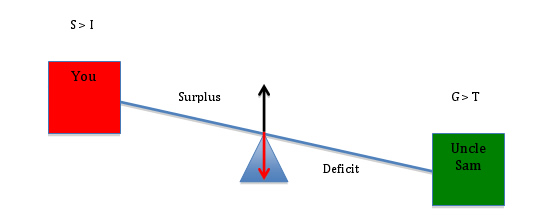
This should make intuitive as well as mathematical sense, because when Uncle Sam runs a deficit, you receive more financial assets than you lose through taxation. Put simply, Uncle Sam’s deficit lifts you into a surplus position. Moreover, bigger deficits mean bigger surpluses for you.
Finally, let’s see what happens when Uncle Sam tightens his belt. Suppose, for example, that we were able to duplicate the much-coveted surpluses of 1999-2001. What would (and did!) happen to the private sector’s financial position?
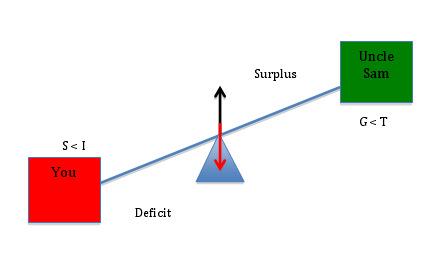
Because the economy’s financial flows are a closed system – every payment must come from somewhere and end up somewhere – one sector’s surplus is always the other sector’s deficit. As the government “tightens” its belt, it “lightens” its load on the teeter-totter, shifting the relative burden onto you.
This is not rocket science, but it appears to befuddle scores of educated people, including President Obama, who said, “small businesses and families are tightening their belts. Their government should, too.” This kind of rhetoric may temporarily boost his approval ratings, but the policy itself will undermine the efforts of the very families and small businesses that are trying to improve their financial positions.
* I’ll be back with a second installment that shows what happens when we ‘open’ the economy to take into account the foreign sector (and the relevant financial flows). Many of us have been working with financial balance equations for years (see here for references), so the current effort is nothing new. I am merely trying to make the arguments more accessible by changing the way they are presented.






27 comments:
Very nicely done, Stephanie. I'll mention this article to those people who have difficulty understanding MMT on the pragcap site.
Excellent piece, thank you!
I like it - but the main idea would stand out more clearly if the initial diagram (and accompanying story) were omitted. By "balancing" the 150 lb person and the 100 lb person on a horizontal teeter-totter, the impression is given that there's something special about that particular equilibrium and hence, when applied to the economy, that the scenario where S=I and G=T is in some way preferable. I suppose you could redraw the initial diagram (same weights, same distances) to show the teeter-totter at an angle - but still in equilibrium. However, that too might confuse beginners (or the President!) so why not start with the GDP relationship and take it from there?
Probably hard to make it simpler than this, as Einstein did say: “simplify as much as possible but no further.” A praiseworthy piece of MMT/macro economics for “dummies”. A clear and simple illustration that nail the fundamentals.
Americans should mail it to Obama and pray that he is still not beyond redemption. :-)
Interesting that the same equations can argue both sides.
If the government has a surplus (GT), S>I implies investment decreases as savings shifts to fund government instead of investment, so growth shrinks.
Of course, the question is how both S and I react to changes in G and T (along with other changes in the economy). Prof. Kelton assumes the private sector is worse off under government surpluses, while I've expressed the other view. These equations by themselves don't allow any conclusions.
The limitations of a simple equation like S-I=G-T are shown in the link in the paragraph about the surpluses of 1999-2001. The graph comparing public deficit to private net savings shows the two being roughly equal until the 1980s when net savings drops below the deficit, then from the mid 1990s on when net savings is consistently lower than the public deficit.
It follows that something new was going on since the mid 1990s since net savings has shifted to a lower level, possibly returning to match the deficit in 2009, though being the end of the graph it will take a few years to see if the earlier trend resumes or if savings remains depressed.
Great job simplifying the key idea, Stephanie. You've still got that crystal clarity thing going.
As yet, however, the argument would not move Obama, who would just dismiss it superficially by saying or thinking that the real economy isn't closed.
We'll have to wait for your second installment to see if the introduction of the foreign sector makes any difference to the cogency of the argument. Of course, it won't.
Sigh.
So, when the government has to spend 100% of taxes on INTEREST on the national debt, and can't do anything about the principal, we will have nirvana?
The problem with the Debt is that for every dollar you spend TODAY, you have to have add a few pennies of interest each year to pay it back TOMORROW.
Also, the deficit spending is abstract in your example. It can buy useless or even destructive things. It is buying the wars in Iraq, Afghanistan, and Libya. How does this help the private sector? It can hire two teams to alternately dig and fill in the same set of holes netting nothing, but you call it productive.
Meanwhile G's share which simply has to pay back people who are cashing in their bonds grows until it reaches something unsustainable.
How is Greece doing? How is Ireland doing? Is their solution more debt? Who would buy it? At what interest rate?
As an accountant, I find it interesting, but slightly flawed on the point that during the surplus corporations "suffered", corporatiosn continued to be profitable, "losses" are "created" for tax purposes, and mainly thought the execessive executive compensation and travel & entertainment expenses. These outrageous (tax dedcutible) amounts are allowed by Boards, who appoint the Compensation & Audit Committees, and are bought, I mean appointed, by the proxy votes, voted by the institutional investment banks, created by the dissolution of pensions and creation of 401k's, also know as the conservative (regan) doctrine, the democratization of money. My next piece is on just this economic myth: How Trickle Down Theory is Ruining our Schools and Closing our Libraries, Thank you Ronald Regan. I will look forward to the next installment.
@ tz who said anything about debt?
Of course things vary in productivity, there are far more productive things than the military, after basic self-defence is provided for...of course, like Keynes, your hole comment is a joke!
Greece and Ireland sacrificed their monetary sovereignty apples as currency issuers to be Euro 'users' or pears, they aren't directly comparable as currency 'users' have a financial constraint, currency issuers don't.
How has the austerity 'solution' 'worked' in the Euro zone? What! It hasn't? But surely by cutting spending there's less debt? Ah, cutting spending causes lower income than there would be otherwise, so debt/income has gone up!
I have read this same story from other economists, and have never understood it. Let me explain what is blocking my understanding, and hopefully you can explain it to me.
Your equation #1 is a “simple identity”. I interpret that to mean that only three of the four quantities is actually measured, by some means, and the fourth quantity is determined from the equation. So, instead of calling it a simple identity, I could just as easily call it a definition. Or saying it another way, the equation has no content; it is merely a definition. I am not sure which of the terms is the defined one. Let me guess that it is the term Y.
The second equation is of the same type. It is merely a definition. Let me assume that it is a definition of the word “saved”, where the economists have a particular meaning to that word which is different from the common definition. Here S is just a number determined from an equation, and the number happens to be called “saved”.
My problem now is that I believe that the no economic information or conclusions can be determined from a set of definitions. I have noticed that economists often hold one or more of these terms constant, and vary the others, and try to draw some conclusion. But that seems to be just play math.
Please explain to me how one can obtain useful information from two equations that are merely definitions of terms.
My other problem is that these two equations seem to have the hidden assumption that the total amount of money is conserved, and that no one is printing it. If I had a money printing press, then the concept of savings would mean nothing to me. In the same way, since the Federal Reserve, and our banks, can increase or decrease the money supply, what is the significance of the word “savings”?
Anonymous,
All of the letters in the first equation are variable. The three on the right side of the equation are directly measured. So Y is "defined" as the sum of those three variables.
In the second equation, S is all the dollars the Government spent minus what the Government took back in taxes minus the dollars that went into Investment(to increase production). None of the variables in the second equation are constant.
The Government spends money as Congress approves in it's yearly Budget. That money all goes somewhere-in somebody's checking account. From there the variables come into play. It can be respent(C), saved(S)sitting in checking accounts or savings accounts, or sent back to the Government in payment of taxes.
So the point is that with a lot of Government deficit spending in a non consuming economy, that money ends up on the non-government side in the form of savings(S).
No theory here. It just is- that's what identity means. The useful information comes in knowing that there is no money printing going on. It's all accounted for. The government decisions to spend are all political. After that the private sector can decide for themselves what to spend or save after they pay their tax obligations. Currently we are saving. During the 90's we spent like drunken sailors(which led to a gov't surplus by the way).
This "simplistic" approach is flawed because there is no universal "you" on the other side of the teeter-totter. Fifty percent of the "yous" are always in the surplus because they never pay into the system to begin with. The other 50% are always into the negative.
And the economy is not a closed loop. Only the private sector creates wealth and expands the economy. (Printing money is not creating wealth.)
Public employees are not productive employees. They are paid by tax monies so all taxes they "contribute" are in the same realm as discounts or kickbacks.
Brj said "Public employees are not productive employees."
Wow. What utter nonsense. So paying people to protect you (and society) is not productive? Killing Osama was not productive? I suppose you could argue that those things don't build anything (i.e. not 'productive') but preventing destruction and providing safety nets is productive in my book. Thank God we don't live in your sad, greedy "I got mine, screw you" Ayn Rand world.
Brj,
Prof. Kelton is referring to a Macro model. Who pays taxes or not is not part of the teeter-totter. "YOU" plural refers to non-government, which is individuals, firms and foreigners as a whole.
The private sector creates production and output from which certain parties may become wealthy. All the dollars that become part of this wealth come from Government- the monopoly issuer of US dollars. Those dollars go into our monetary system by the government spending and crediting non-government accounts.
Next time you see a cop or a firefighter or a teacher or a serviceman or a crew paving a highway, stop and tell them how unproductive they are. See how you are received.
Chewitup said... "All the dollars that become part of this wealth come from Government."
The dollars themselves are not the wealth. It's merely how we exchange things of value amongst each other. In a fiat monetary system the value of that dollar his only worth what we believe it to be.
I never said that the service provided by public employees was not valuable, it simply does not create wealth. As government monopolies they are wealth wasters without the self-correcting influences of the market. If your police department is corrupt you can't hire a new one. If your teachers don't educate students you can't replace it.
However, a paving crew is most likely a private company working on contract. If they do a lousy job the state has a recourse.
Ah, isn't most of the surpluses due to fiscal policy being created in foreign nations, who export to us? The U.S. private sector is even more in deficit then the public sector.
Brj,
so - if service by public employees does not create wealth, then privatizing public services surely would?
Would private army create wealth? Or private firefighters and private police?
It would be interesting to see private army. I guess investors would buy it ammunition and gear and the army would create wealth by pillaging?
Then private police would create wealth by racketeering?
And private firefighters would create wealth by charging people for their services?
This is a nice demonstration.
Just to point out that it might confuse, though. Those weights look like stocks, when they're actually flows.
@brj
The point of public infrastructure is to lower the cost of doing business, not produce a profit.
Contrary to your belief, almost all wealth & innovation comes out of the public sector.
Aviation, transistors, microchips, computers, the internet, biotech, aerospace, etc, all came out of the state sector, funded and developed to be handed over to the private sector for profit.
Remember, it's the Nanny State that made (& continues to make) Bill Gates rich. If it wasn't for the state forcing people to pay him for "his" intellectual "property", he would be nothing but a poor college drop-out.
The same could be said of many others.
great article. When will the part 2 come? I really want to read about the foreign sector as well soon!!!!
Make sure you post it please and thank you again!!!
@Vilhelmo
Sorry, you're wrong about the primary source of innovation. Taking a few of your examples:
Avation: Started by the Wright brothers, privately developed. William Langley previously spent $50,000 of government money, failed, and his work wasn't formally "handed over" to the Wright brothers for profit. Today large aircraft makers can take advantage of government money for military aircraft, which some claim subsidizes commercial planes.
Transistors: Developed at Bell Labs, based on both privately developed technology and WWII work.
Microchips: Texas Instruments, Fairchild Semconductor.
Microcomputer chips: Invented at Intel for a calculator being designed for a Japanese company.
Computers: Earliest digital machines developed during WWII (with government involvement) based on concepts developed over the previous 100 years. Most developments after this by private companies.
Internet: A combination of government (Arpanet) with private contributions (e.g. Usenet). Note that the world wide web, while developed at a government funded lab (CERN) was not part of their primary mission (particle physics).
Biotech + the space program have been largely government funded.
There has been government involvement in all of these technologies at some level but the "government developed and handed over to the private sector" model only fits a few technologies and only in the last 50 odd years.
While we all love to hate Bill Gates, Microsoft did not become the large company it is today by relying on intellectual property. Microsoft sold largely to hobbyists in 1980. It got its first big market from the IBM PC because it was selected by IBM at least 1/3 cheaper than the two alternatives (CP/M-86 and UCSD P system). I doubt they had any patents at that time (software patents weren't allowed). Microsoft basically piggy backed on the success of the PC standard. By the time intellectual property became an issue, Mr. Gates was already a billionaire.
There are also alternatives to every Microsoft product on the market, I'm unaware of any law forcing people to pay Microsoft anything.
In terms of intellectual property, if that's "government support", then all authors, musicians, and filmmakers (who all depend on copyright) must only make money because the government. But at this point I think the argument becomes absurd. Governments exist, laws exist, if that's state support you've just defined all economic activity as state supported.
This isn't to say that government isn't involved in research and doesn't fund a lot of work that is converted into commercial products. Saying "almost all wealth and innovation comes out of the public sector" does not fit the facts.
@tz
Someone correct me if I am wrong but, government deficit doesn't necessarily imply a corresponding government debt. From what I've learned of MMT, debt issuance has to do with interest rate maintenance, not with funding government deficits. The government funds itself by spending. If you don't want to issue debt then one could maintain a zero overnight interest rate policy or pay interest on reserve accounts, if that was a desired policy. In addition, debt could be issued for special purposes such as retirement, education, etc savings.
I'm trying to understand this more, so forgive my ignorance in advance.
My question is, why is it bad for S < I?
What will happen if this situation continues for a long period of time?
Sorry for another dumb question...
Does a private sector deficit (S < I) imply a corresponding private sector debt?
Thanks,
William.
Awesome post - but as anonymous asks above (s/he never received an answer), how do you account for the external force of the Federal Reserve and the printing press? How do these equations take in to account new dollars being injected into the 'closed' system by the Fed?
I disagree. Each time a person spends money, that choice came from an inner motivation. And each time a person earns money doing that work came from an inner personal motivation. And every bit of the economy occurred through such an action. And you can't quantify human actions. So the whole idea of creating a mathematical equation to discern how an economy functions is absurd. Which is why not a single economic theory since Adam Smith as ever been followed and produced a more viable economy.
Post a Comment